Why Staffing firms are not winning, despite being one of the most strategic teams


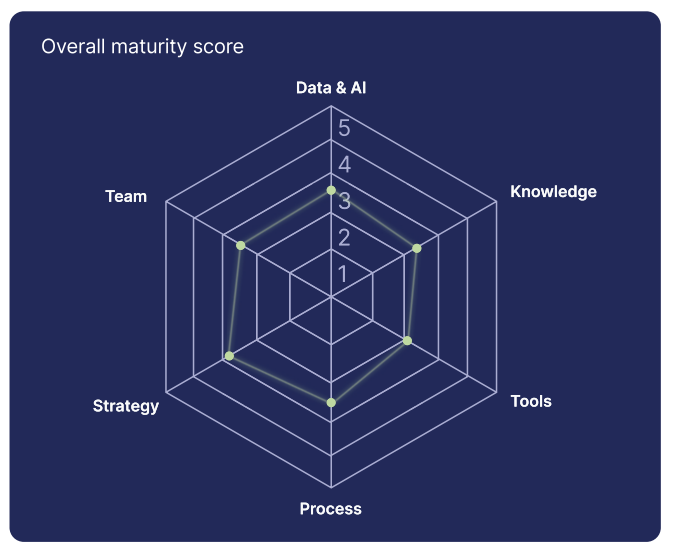
Across the six industries we benchmarked in our State of Bid Management Report, staffing and recruitment teams scored highest on the hardest skills to teach: reading a client, building the relationship, finding the angle that wins. Their average win rate is the lowest of the six.
Staffing companies are known for being great at the strategic side of bidding, reading a tender and knowing exactly how to position against it, and our latest State of Bid Management Report confirmed it. We benchmarked bid teams across six industries, and staffing and HR teams scored highest on strategy, the judgement-heavy part of the job, also including:
- bid strategy,
- client understanding, and
- involving the right people at the right moment
They also run leaner than anyone else we looked at: 14 documents per tender, 6.3 collaboration tools, and only 19% of bid time lost to administration and coordination.
And yet the average win rate is 39%, the lowest of the six industries we looked at. Across the survey, 58% of bid teams tell us they're not satisfied with the rate they're winning at.
So if these teams are that good at the part of bidding that's hardest to teach, and efficient on top of it, why aren't they winning more?
Something is broken in the process, and it isn't something a better drafting tool will fix. That's what I want to tackle in this blog.
Human craft wins bids, but it doesn't scale them
That strategic read usually sits with a handful of experienced bid managers. Staffing companies have done a good job hiring, onboarding and building processes that let strong bidders do their best work. But it leaves two things exposed:
- When an experienced bid manager leaves, the knowledge walks out too.
- Growth means finding and onboarding more senior bidders, and they're scarce.
Both are survivable if the knowledge is captured somewhere. Our research says it usually isn't: 62% of bid teams say losing a key bid professional would have a high to very high impact on bid continuity. And of the six dimensions we benchmarked, tools is where staffing teams score lowest, despite being the leanest operators in the set.
So once a bid is submitted, most of what made it good, such as the qualification call, the winning angle, specific compliance answers, evaporate. A brilliant team running on instinct can only be in so many places at once.
The knowledge exists. It just isn't treated as an asset, and that's not only inefficient, it's expensive.
Faster drafts, same decisions
The “obvious move in 2026” is to throw AI at the exposed gaps. Most teams already have: 61% use AI primarily for drafting or isolated tasks.
But an AI assistant can only work from the context it can reach, and that context is exactly what went missing. If last year's winning angle was never captured, no model can resurface it. So drafting gets faster and nothing else changes: 69% say key bid decisions are still made without consistent data or insight, and 74% don't consistently use insights during qualification, prioritisation or reviews.
Speed increases. Clarity doesn't.
You see it the moment a team drafts with a general-purpose assistant: the output reads in a generic voice, misses the compliance and risk issues that deserve a second look, and knows nothing about why you lost the last tender. Better prompts won't close that gap.
And there's a quieter risk. As Rens Zwakenberg, Proposal Manager at BDO, shared in our research interviews: everything AI produces sounds credible if you don't have deep, current knowledge of the subject, and an expert spots the gaps immediately. A proposal can look finished very quickly. That isn't the same as being correct.
For staffing teams that's the sharp end, because your advantage is judgement, and confident unverified text puts exactly that at risk.
So the question isn't whether to use AI. It's whether your process is set up to get value from it.
Turning repeat tenders into reusable work
Staffing tenders repeat themselves. A single group may bid across several brands, countries and service lines, so every tender is at once familiar and bespoke, and framework agreements come up for renewal on a predictable cycle. Compliance and right-to-work, vetting and fulfilment SLAs, DE&I and social value, pricing and account governance: the same ground, tender after tender.
And yet companies tell us they answer these from scratch every time: rewriting from an old proposal buried in someone's inbox, or worse, from memory. It's the definition of work that should compound and doesn't.
The teams pulling ahead run each bid as a repeatable operation instead of a blank-page scramble: requirements mapped once, risks flagged early, proven content reused smartly rather than just pasted, and gaps routed to the expert who can close them. Qualification sharpens too, so senior hours stop going to bids that were never winnable.
This is where AI earns its place: reading a 200-page tender pack and surfacing the requirements, risks and deadlines in minutes instead of days, and resurfacing your own proven content so no one starts from a blank page. The judgement of what will win stays with the people who know the client. It's the shift strategists now describe as moving people above the loop: directing and judging the work rather than grinding through it.
Johannes Kristian Schmidt, bid manager at staffing and recruitment firm Epico, describes the difference on the risk side:
"Going over a full contract to spot red flags, payment terms or compliance issues is time-consuming. Altura's 'Risk Analysis' workflow makes that initial assessment in minutes, and the result is easily verifiable through precise source-tracing."
None of that replaces the instinct that makes staffing teams good. It gives that instinct a memory, and a way to travel across more bids than any one person can personally touch.
The strategic read for a commercial leader
Bid management has spent decades as an operational cost centre. In staffing, it's quietly one of the highest-leverage commercial functions you have: every framework won or lost moves revenue for years.
And the stakes keep rising. The UK has more than 30,000 recruitment firms, and the sector adds over £40 billion a year (REC); across Europe there are an estimated 150,000-plus staffing businesses (IBISWorld). The Netherlands alone has around 20,000 agencies competing for a flex market worth roughly €47 billion (FlexNieuws), and that market has stopped growing: ABU recorded hours down 5% across 2025 with revenue flat.
Much of that work is awarded through formal tenders: 227 flexible-labour tenders on TenderNed in 2024 alone, worth €7.8 billion (Flexnieuws), against around €800 billion of EU public contracts a year (TED). When the market isn't growing, share has to come from winning more of what's already on the table.
The firms that pull ahead won't be the ones with a new secret to relationships or sector knowledge; the good ones already have those. They'll be the ones who turn a strength that lives in people's heads into a system that compounds: better qualification, less senior time lost to admin, higher win rates on the bids that matter. That's how 39% moves.
And it scales. When one manager can qualify and evaluate in a fraction of the time, you pursue twice the bids on the same headcount.
Your team is already good at winning. The opportunity is to make winning something your business does on purpose, every time.
Or see how Altura helps staffing and recruitment teams turn every bid into a reusable asset — book a walkthrough.
Further reading for commercial leaders
The shift underway in bidding is part of a bigger one boardrooms are already debating: how AI changes not just the tools, but the workflows, the roles, and where human judgement sits. A few pieces worth your time:
- McKinsey — AI is everywhere. The agentic organization isn't — yet (2026). Why so much AI investment hasn't moved the bottom line: companies bolt AI onto old workflows instead of redesigning them — and why leadership is shifting from "human in the loop" to "human above the loop." Read it
- McKinsey — The State of Organizations 2026. Makes the case for AI as a "double transformation," technical and organizational — with the reminder that the returns come from redesigning how you operate, not from the technology alone. Read it
- Harvard Business Review — How Do Workers Develop Good Judgment in the AI Era? (2026). As AI absorbs the repetitive work that used to build expertise, judgement becomes the scarce asset — a direct challenge for any team whose edge lives in its most experienced people. Read it
- Lohfeld Consulting — How the State of Proposal Management Is Changing in 2026. A view from inside the bid profession: how AI-assisted workflows — compliance matrices, past-performance matching, first drafts — let leaner teams cover more bids without dropping quality. Read it
Sign up for our Newsletter
Sign up for great tips, tricks and other bid management news!
.png)
.png)
.png)
Discover the power of automation in 30 minutes.
We'll walk you through a live bid on your own documents, showing you how ALtura brings clarity and flow in your tenderprocess.