Writing winning proposals starts with context, not a blank page.
A tender gives you the requirements and award criteria. Altura pulls those together with your own evidence, strategy and best past proposals, and drafts each answer from them. So every answer is written for this tender, not a generic template, and your team spends its time judging the answer instead of inventing it from scratch.
Writing is rarely the real bottleneck.
Missing context is.
Your context is scattered.
The requirements sit in one document, the risks in another, your evidence across a dozen past proposals, and the sharpest details in a colleague's head. So you spend the run-up to the deadline hunting for it instead of thinking.
No overview while you write.
Once you are deep in the writing, the whole bid lives in your head. It is hard to see what is done, what is still weak, and what has been missed entirely.
Generic AI makes it worse.
Point a general AI tool at your old proposals and it recycles yesterday's bid for today's tender: fluent, confident, and wrong for this buyer. And once a polished draft exists, the team starts checking sentence length instead of asking what is missing.
Build the case before you write it.
Understand the criterion.
For each award criterion, capture what is asked, how it will be scored, and what the buyer's actual need is behind it.
Build and choose the case.
Gather the evidence from your own proposals, each with its source, the buyer's feedback and its limitation. It lands in your tables, so Altura does not have to go looking again. Weigh the angles you could win on, set the promise you will make, and decide the approach: how you will actually deliver it.
Draft and check.
The Bid Companion writes from all of it. Then it checks two things: that every claim is backed by your evidence, and that what you are promising is suitable and allowed under the tender.
The point is not to skip the thinking. It is to do it first, so writing becomes checking, not composing.
Four steps from a tender to a draft you can stand behind.
Analyse and structure the tender.
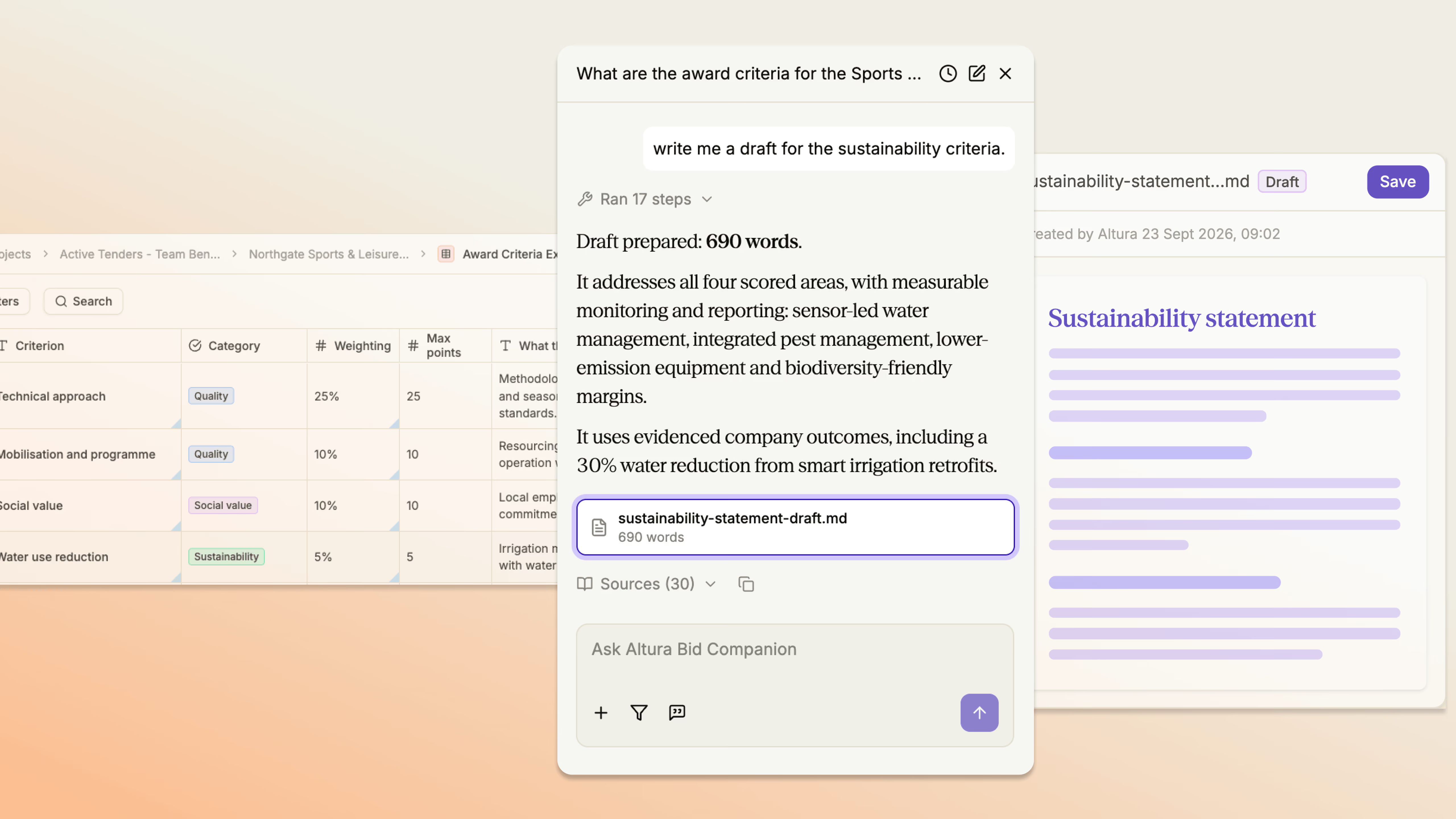
Altura's AI workflows read the tender and pull out what matters: the requirements, the risks and the award criteria. It all lands in your Bid Book, the shared set of tables where the whole team works.
- Run workflows for tender analysis, requirements, risks and award criteria, instead of reading every document by hand.
- See every requirement and criterion in your Bid Book, including how each one will be scored.
- Add your own judgement, SME input and team notes right where the work happens.
- Keep everyone aligned as documents and stakeholder input change, with updates flowing through to the Bid Book.
By the time you write, the thinking, the evidence and the team's input are already in place.
Reuse past proposals, effectively.
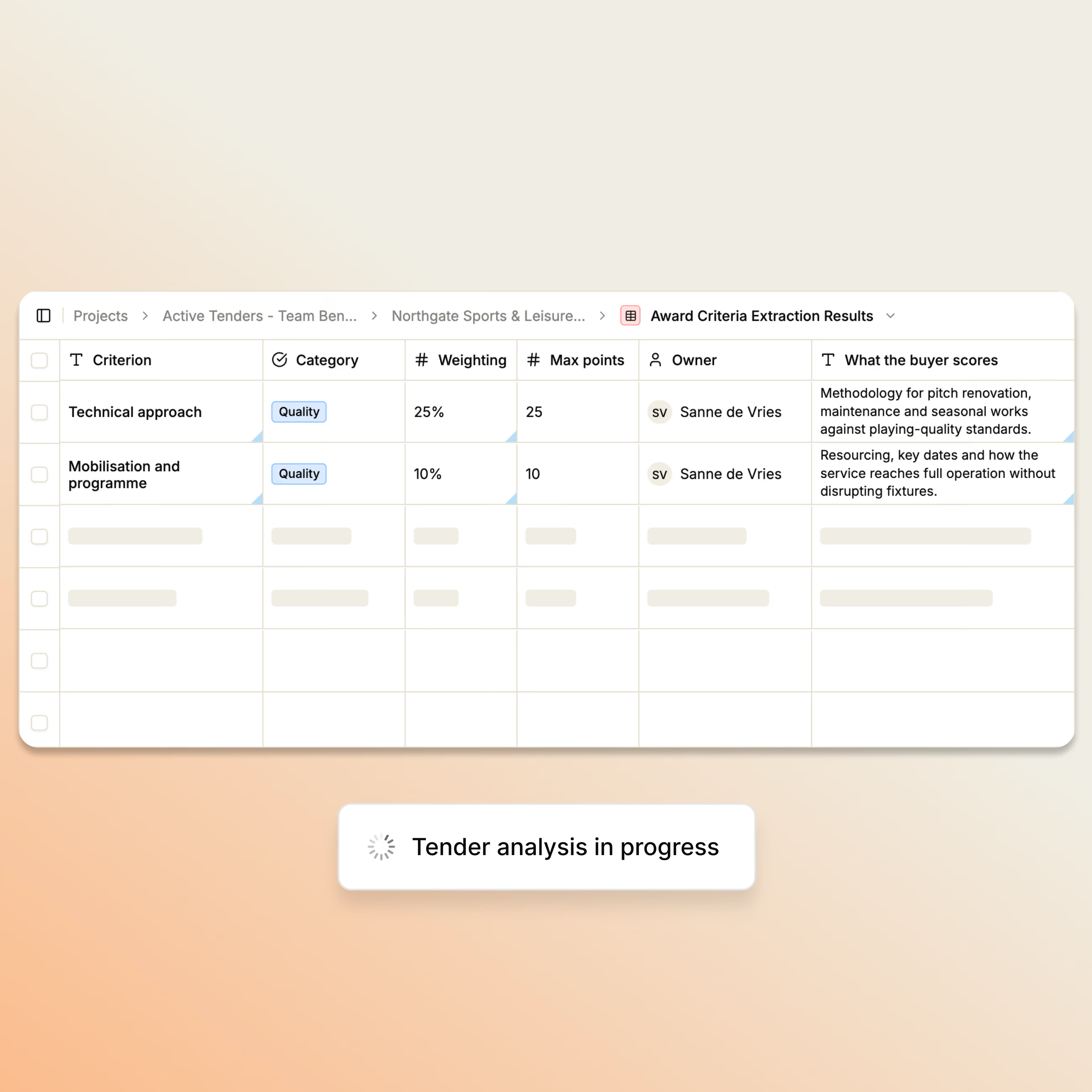
Your best answers are already written. Altura helps you find the ones that fit this tender and reuse them with confidence, because you can see how each one performed last time.
- Every piece of evidence comes with its source, whether that bid was won or lost, and the buyer's own feedback on it. So you know what is safe to reuse and what to fix first.
- The feedback is Altura's reading of the real award decision: why the answer won or lost, in the buyer's own words, and where it fell short. Not a star rating you have to second-guess. The reason behind it tells you exactly what to keep and what to change next time.
- Filter your Knowledge Library by what matters: client, sector, product, region and anything that is relevant to you.
- The more you add to your Knowledge Library, the more useful it becomes. Every proposal, evaluation and award decision is there to reuse on the next bid.
A first draft, built from your case.
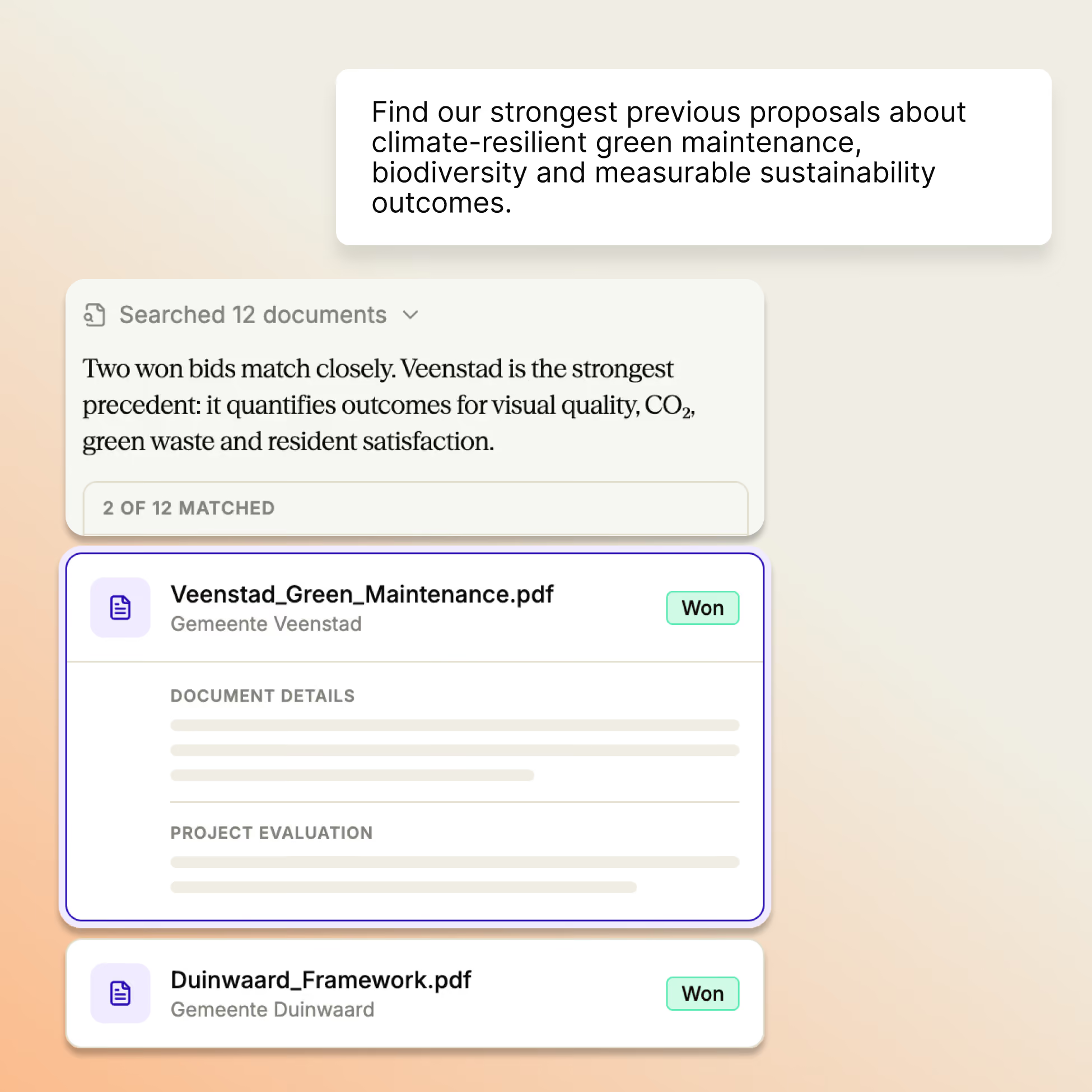
With the case built, the Bid Companion writes the first draft from it. That is the shift: instead of thinking up what to write, you read what is there and decide whether it is right.
- A fully written draft, answer by answer, built only from the evidence you gathered. It never invents what it cannot back, and marks the gaps it could not fill.
- The draft opens as a clean, readable document, not a chat reply, so you review it the way the evaluator will read it.
- Written the way the criterion is scored, to the word limit, and opening with the promise your team chose, which it also checks you are allowed to make: no deviating from the requirement, no promising a result where only effort was asked, no pricing yourself out.
- Save each draft straight into your project files, so the whole team can see it and carry on with it. Or copy it into Word or Teams to finish there.
Spar with the Bid Companion.
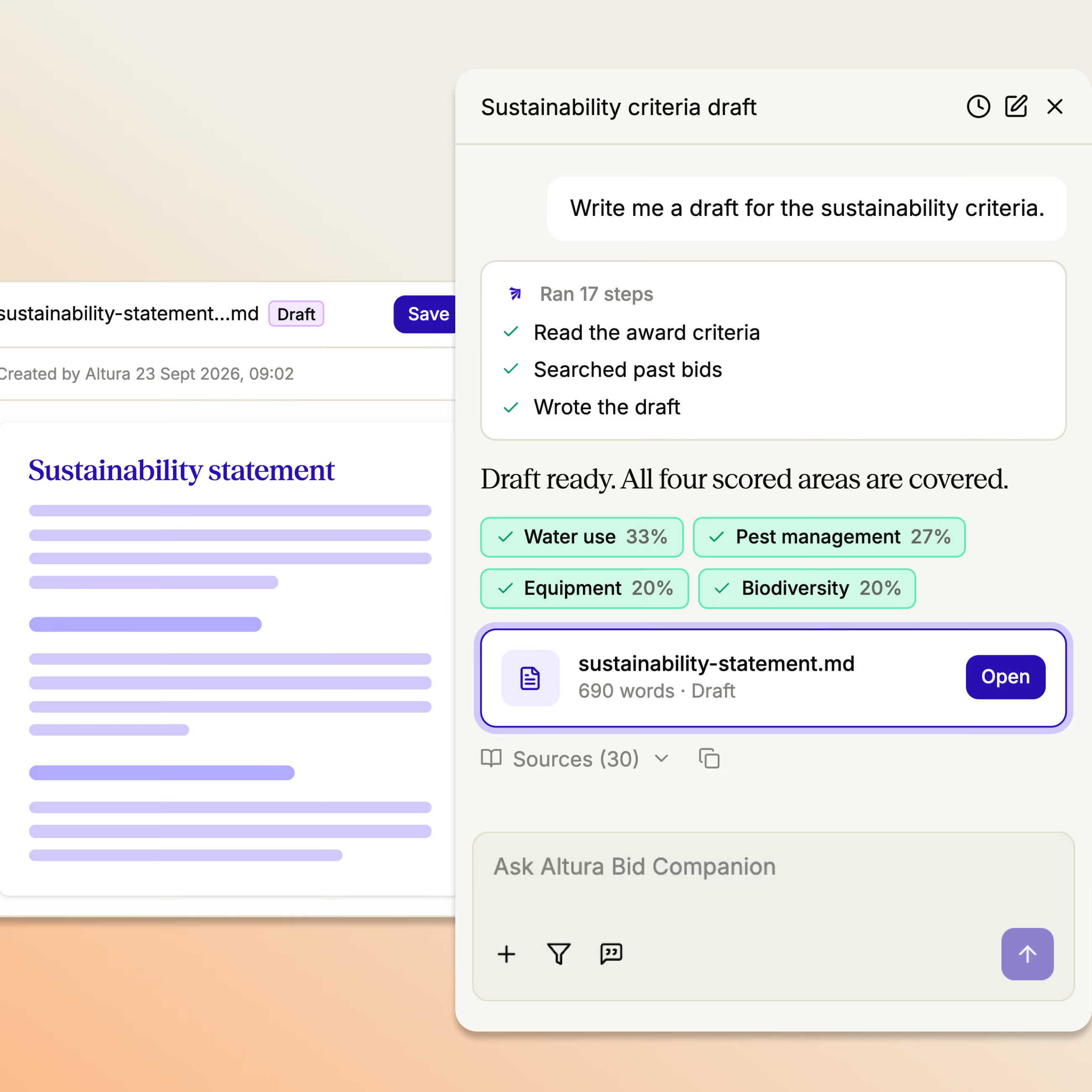
It is not a push-button draft. You work with the Bid Companion like a sharp colleague: challenge the angle, strengthen a weak answer, pull in more proof. It pushes back, and the answer gets stronger with each pass.
- Fine-tune it by chatting: shorten, sharpen the win theme, adjust the tone, until it is the version you would actually send.
- Ask it to check its own work: does the answer cover the whole requirement, is every claim backed, does it answer the question behind the question.
- Put it to work across everything you have: ask for every mention of implementation, timelines or risk from dozens of documents, and get it back in seconds.
- Keep it consistent with the Prompt Library: use Altura's prompts, or save your own and your team's, so every answer follows the same format, style and structure.
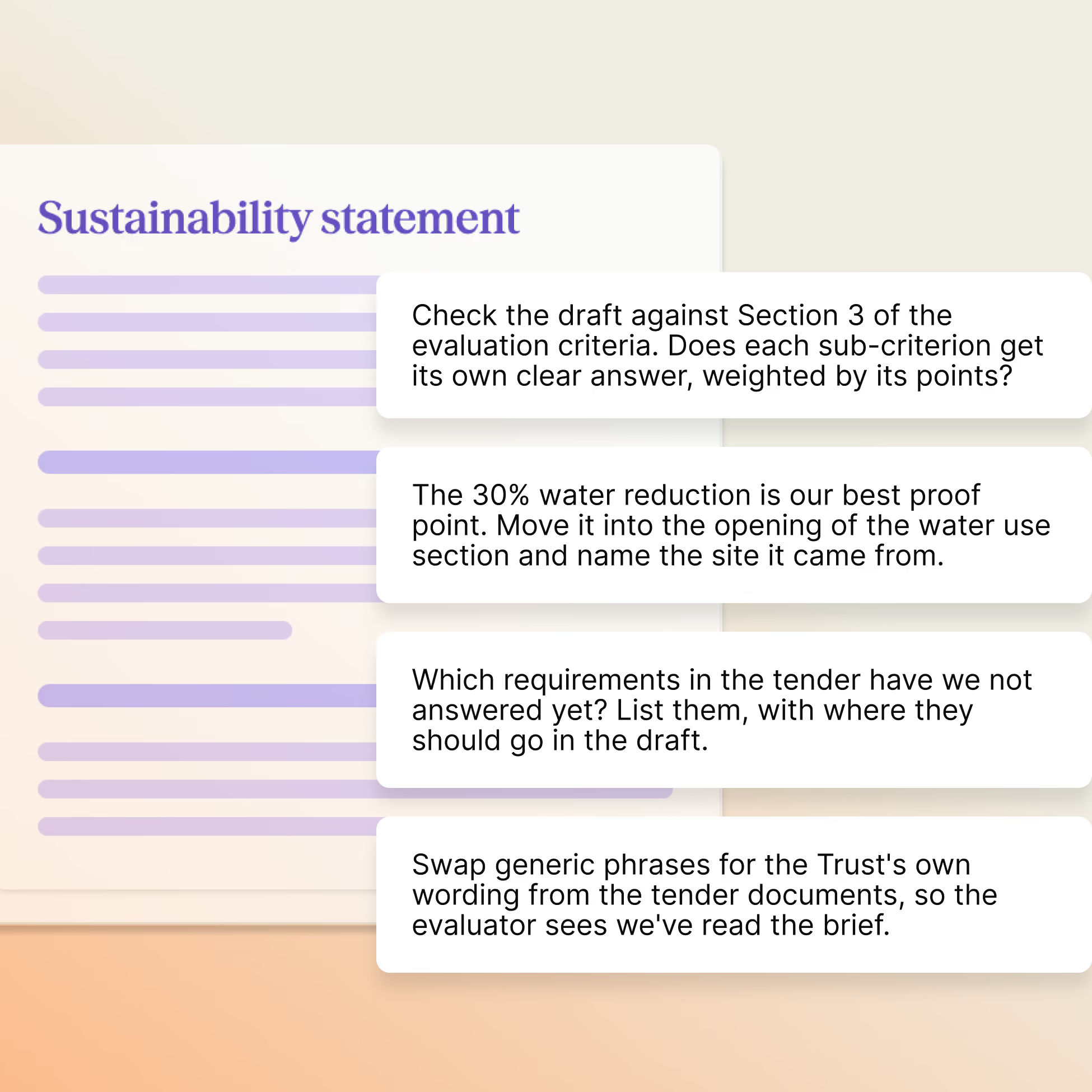
Fits around the setup you already have
Already got your own AI setup dialled in? The prompts, the tone, a way of working that fits how you write? You do not have to swap any of it out.
What Altura can add when you want it: the structured tender context, the evidence and the right past answers underneath your answer. So you keep writing with what you know, with a firmer base for this bid beneath it.

AI does the legwork. Your team wins the bid.
Human guardrails
Altura drafts and checks, but nothing reaches the buyer until your team signs it off. The promises and the claims are always yours to make.
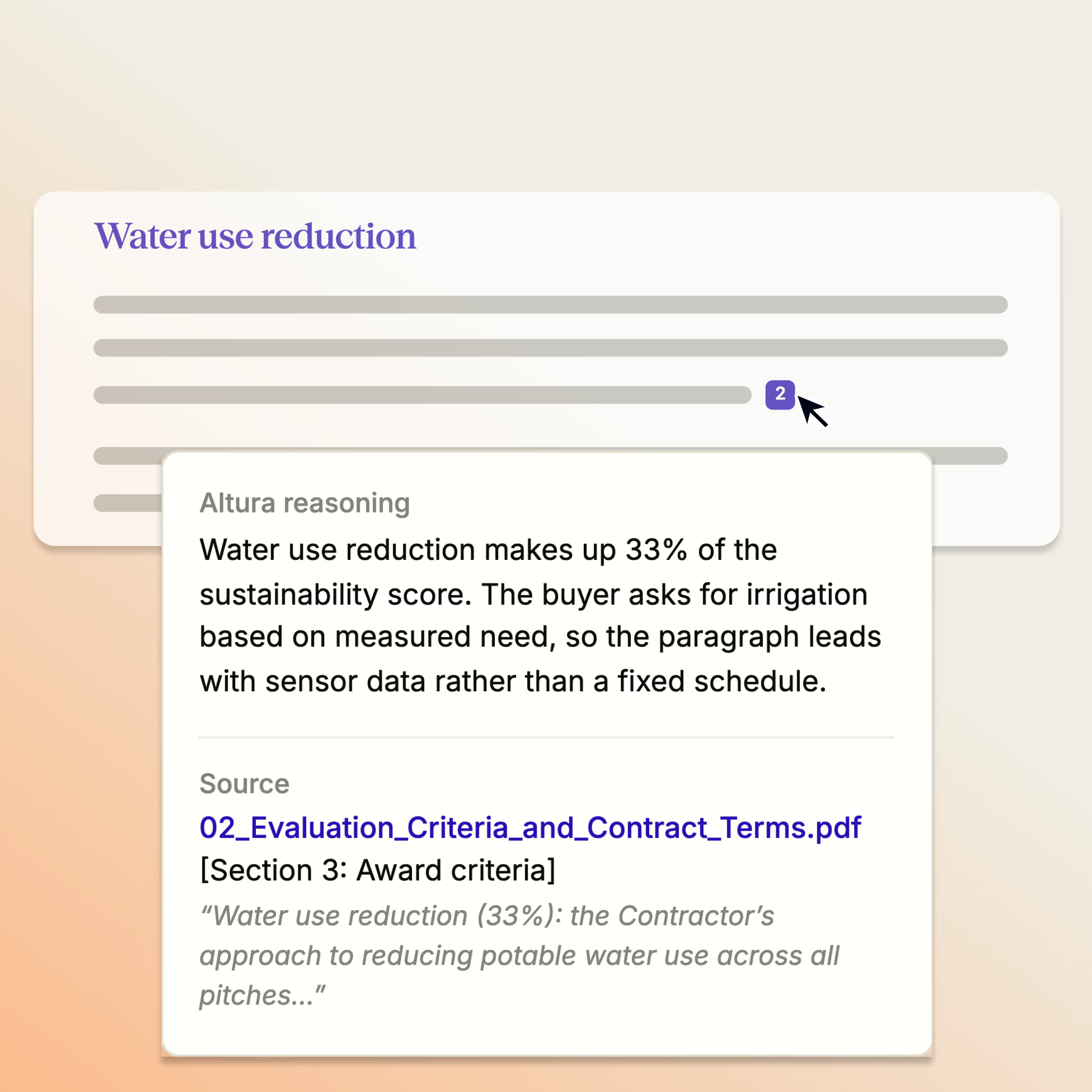
AI explainability
Every draft shows where each line came from and flags what is still missing, so you are never guessing what the AI used or left out.
Discover how Altura improves your writing process.
Book a 30-minute demo and we'll walk you through the platform with your bidding process in mind.

Frequently asked questions
Altura turns the tender's requirements and criteria, your evidence and your strategy into a credible first draft, one answer or section at a time. It takes the slog out of the blank page while your bid team keeps control of tone, win themes and the final call.
The Bid Companion grounds every draft in the tender documents, your project data and your Knowledge Library. You set the requirement, the evidence, the angle and the word limit, and you can trace every line back to where it came from.
Yes, and safely. It finds relevant past answers, evidence and case studies, shows you how each one scored and what the buyer thought, and adapts them to this tender rather than copying old boilerplate.
It works answer by answer or section by section on purpose. That keeps each draft stronger and easier to trace, so you can check every claim, tailor the response and keep your bid strategy intact.
Ask the Bid Companion to check whether a draft covers the whole requirement, backs up its claims and matches the evaluation criteria. It can tighten the structure, tone and length, including to a word or character limit.
Still have questions?
Talk to the team. We provide answers based on your specific process and requirements.