Your risks, surfaced and flagged against your unique criteria.
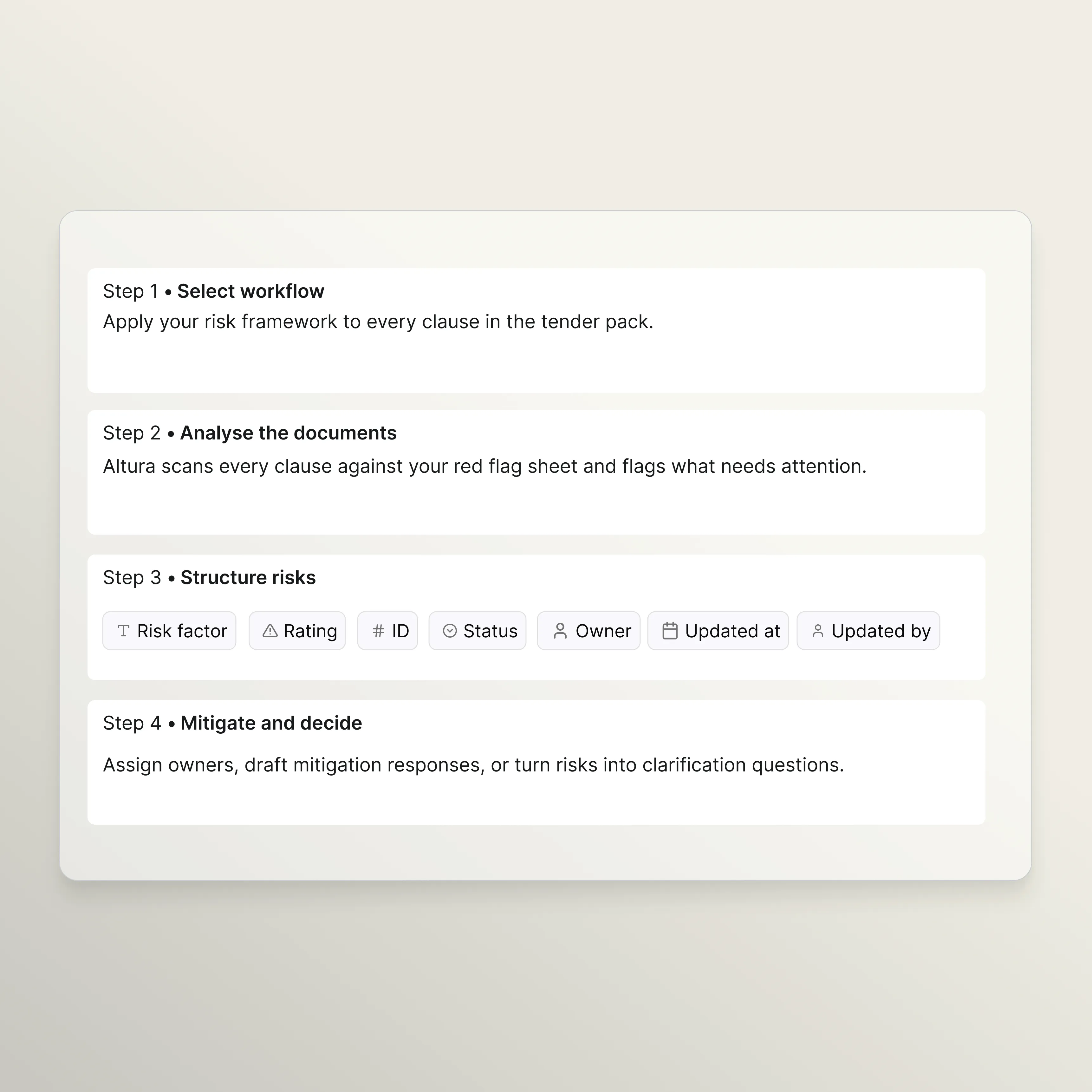
Altura scans every clause in your tender pack against your organisation's risk framework. Each finding comes with a red, amber, or green rating, the source clause that triggered it, and the reasoning behind the assessment. Your criteria. Your judgement. Your final word on every risk.
The risks you catch late are the ones that hurt.
Unlimited liability buried in clause 14.3. A penalty regime hidden in an annex. An unrealistic timeline that only becomes obvious after you have committed. Most teams discover these at the wrong moment, when it is too expensive to walk away.
Altura catches them on day one.
Three steps to controlling risk in every tender
Detect risks against your own framework.
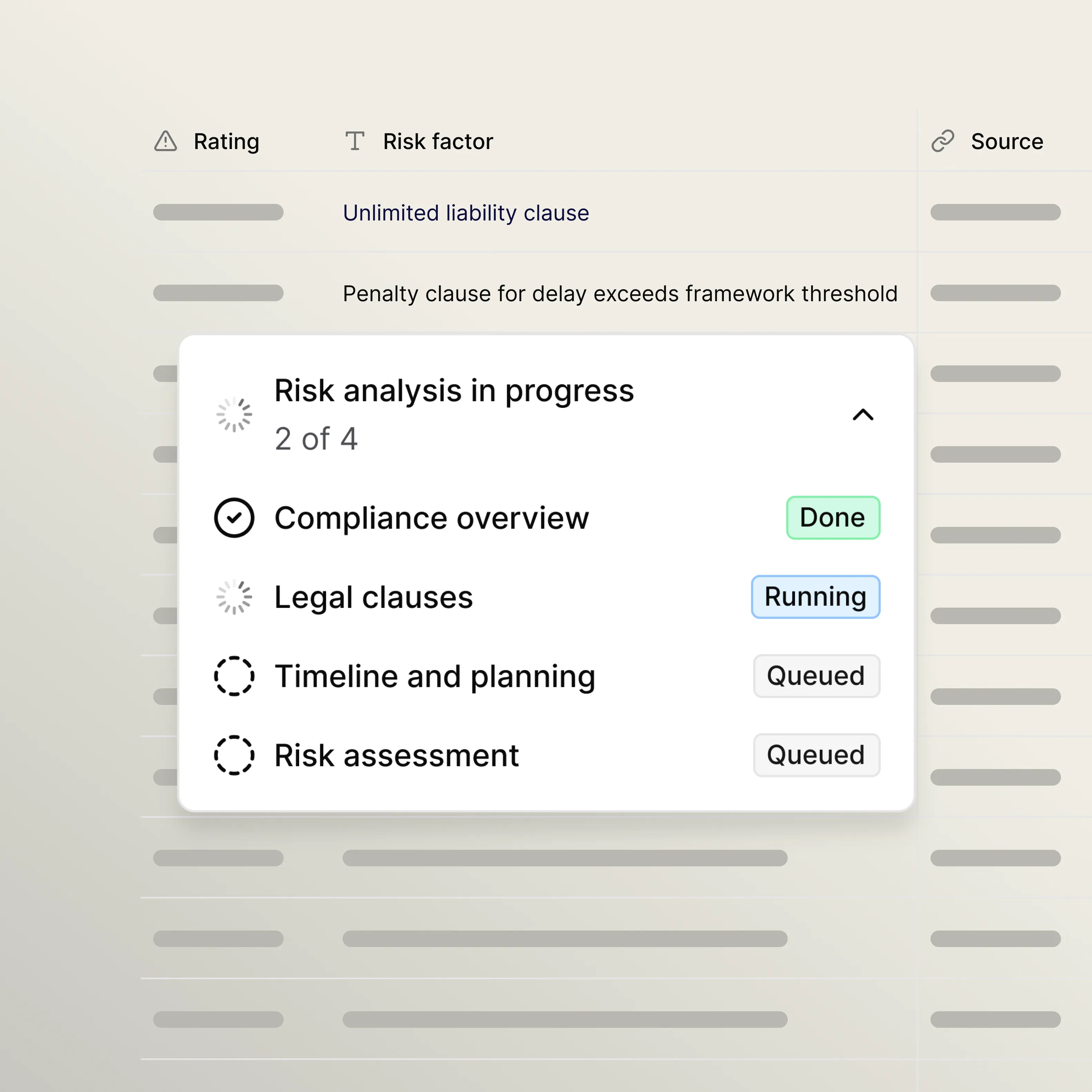
Upload your tender pack and Altura scans every clause against your risk framework. Unlimited liability, unrealistic timelines, penalty exposure, unreasonable IP terms, anything your team has defined as a risk. Each finding comes with a red, amber, or green rating, a direct link to the source clause, and the reasoning behind the rating. If you do not have a framework yet, our team can build one with you from your past clarification rounds.
Organise risks, assign owners, track status.
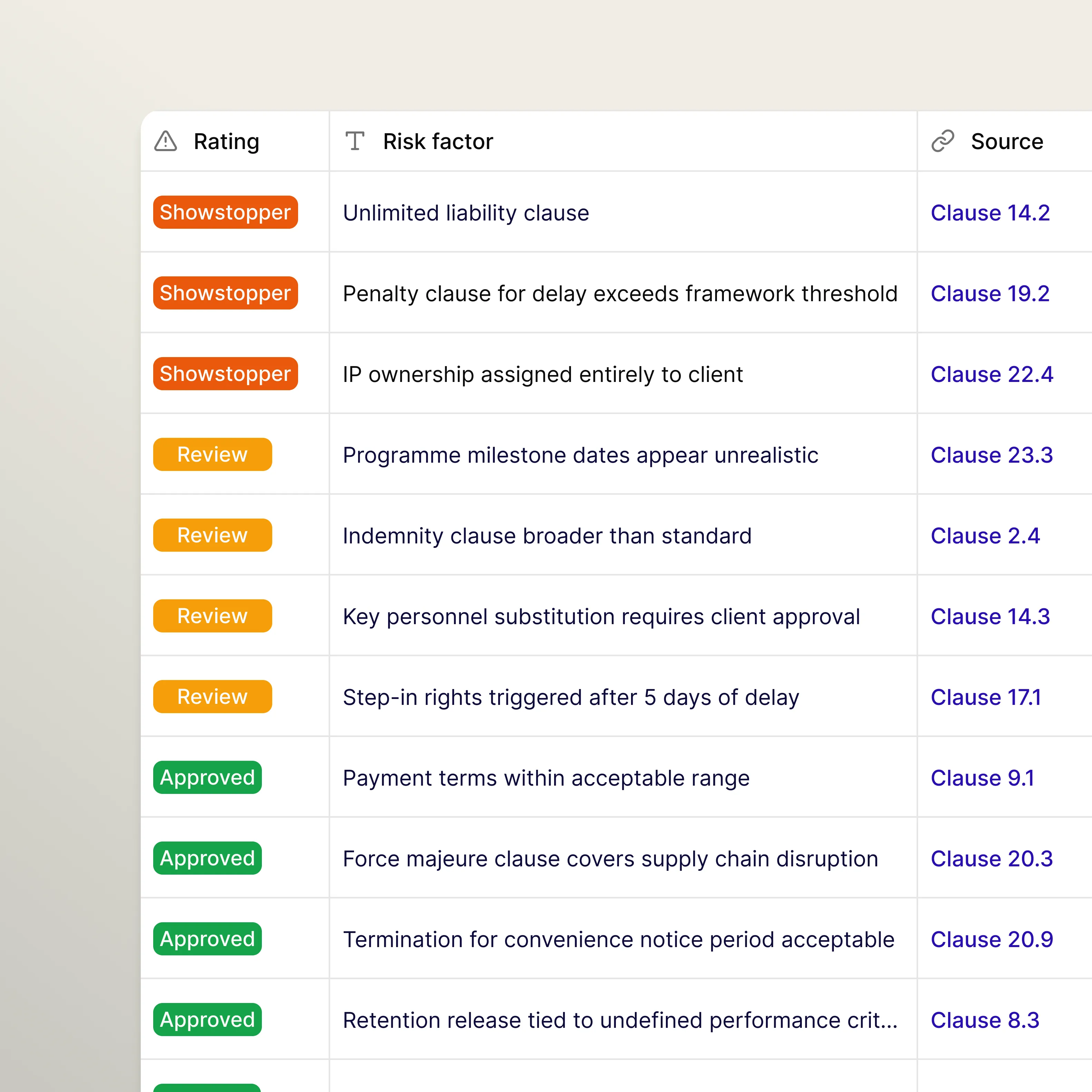
Risks land in a structured table inside the Bid Book, with severity ratings grounded in your own definitions. Assign owners, set statuses, and track what is open, accepted, mitigated, or escalated. The risk overview becomes a shared, living view your team and leadership can reference at any point in the bid, with a clear picture of where exposure sits and who owns the next move.
Mitigate and respond with full context.
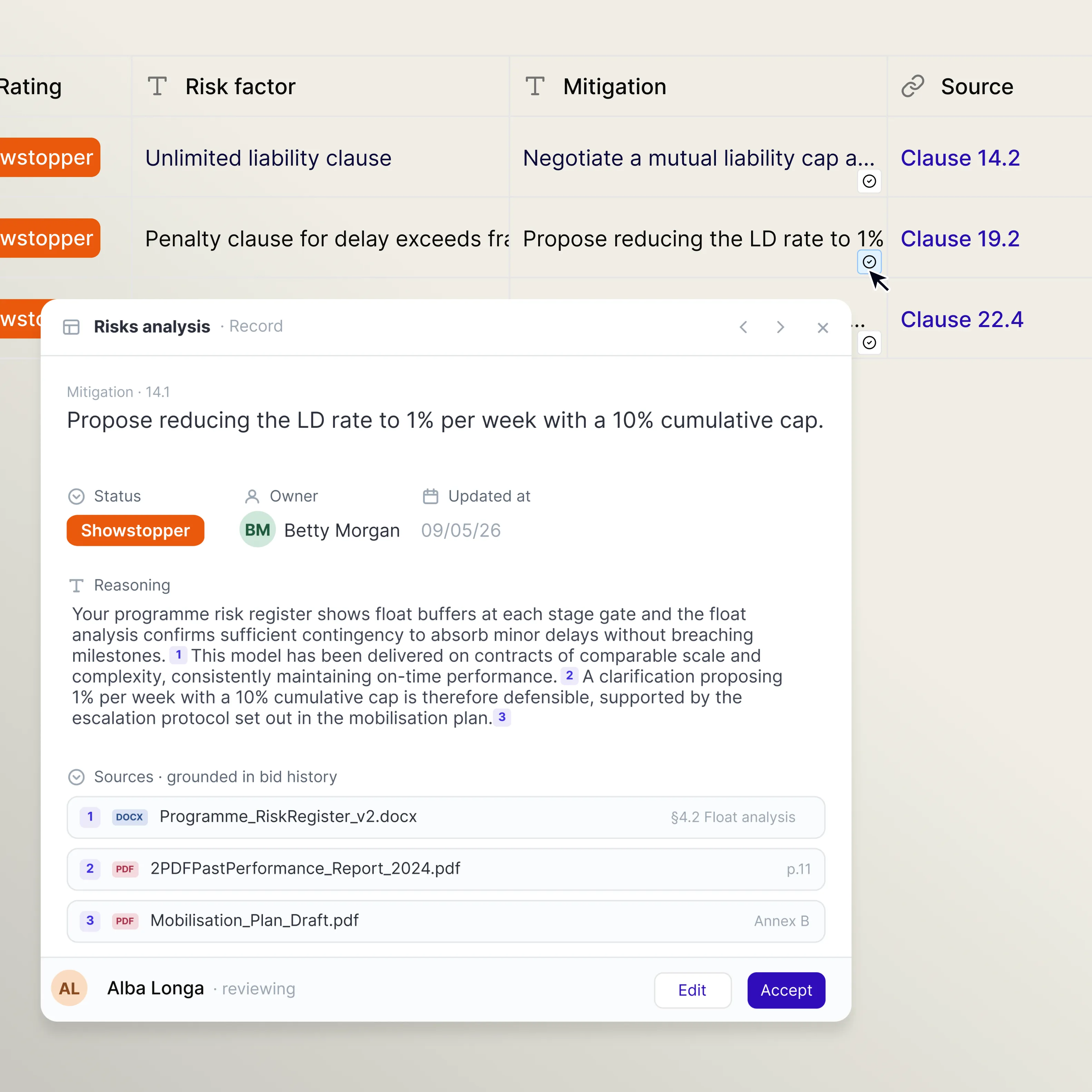
Identified risks flow directly into clarification questions, go/no-go decisions and mitigation plans. The AI can draft mitigation responses based on your past tenders and internal knowledge. Every suggestion includes linked references so claims and policies trace back to the right source. Risk owners review, adjust or write their own response with the Bid Companion to refine the final answer. When clarification answers arrive, Altura updates the affected risk assessments automatically.
Need a workflow tailored to your unique process?
Our core workflows are highly configurable, yet we know that complex bid processes often require a more personal touch. We offer a direct partnership to help you build specialised workflows tailored to your team’s unique requirements, ensuring Altura stays as flexible as your strategy.

Enterprise-grade automation with security you can trust.
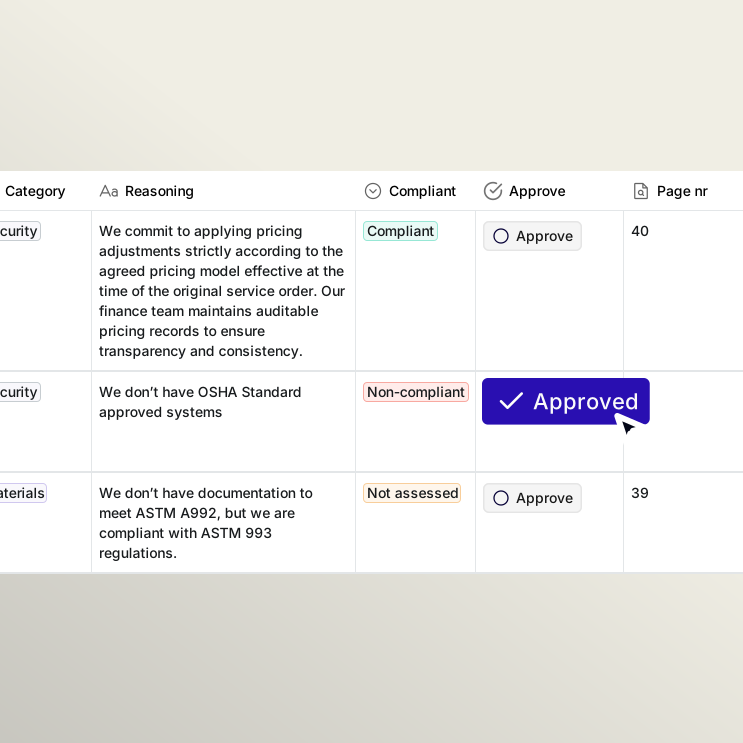
Human guardrails
You stay in control of the data used for every answer. AI-generated content is clearly marked, and you approve each response before it moves forward. Your team decides which sources the platform can draw from.
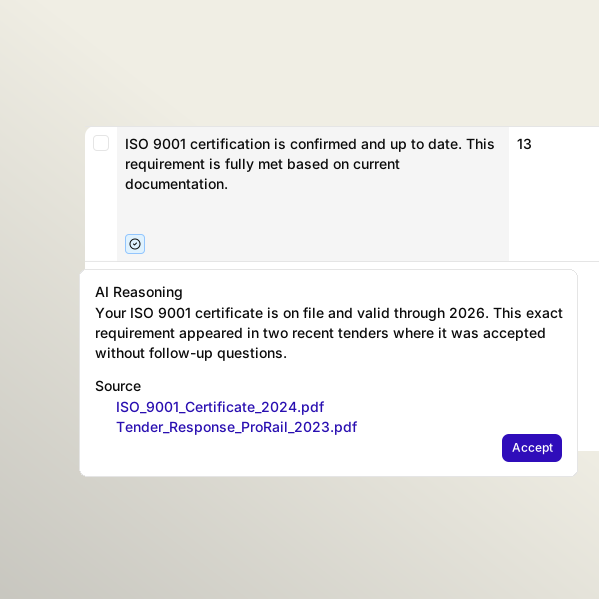
AI explainability
Altura prioritises clarity. Every insight includes the reasoning behind it and a direct link to the source data at a word level, ensuring your decisions are always verifiable.
Stop losing days to manual requirement extraction and guesswork.
See how Altura helps your team extract, assess and answer every requirement in a structured workspace, with traceable sources and clear confidence indicators on every line.

Frequently asked questions
A thorough tender risk analysis involves scanning every document in the tender pack for conditions that could create financial, legal, operational or delivery risk for your organisation. This includes unlimited liability clauses, unrealistic timelines, penalty exposures, single points of failure and non-standard contract terms. Altura automates this by reading your full tender pack and flagging risks based on your organisation's own criteria, linking every finding back to the exact clause in the source document.
A red flag sheet is a document where your organisation defines its risk criteria: the specific conditions, clauses and terms that should always be flagged when reviewing a tender. Examples include unlimited liability clauses, penalty regimes above a certain threshold, or contract durations that exceed your planning horizon. Altura uses your red flag sheet as the primary lens for risk detection, ensuring the analysis reflects your organisation's risk appetite rather than generic AI scoring. If you do not have one, the system can still flag risks based on common tender risk patterns.
Risk severity ratings are grounded in your own definitions, not generic categories. You define what "high," "medium" and "low" mean for your organisation, based on your risk appetite, deal size thresholds and operational constraints. The system applies those definitions consistently across every tender, so risk assessments are comparable over time and aligned with how your leadership actually makes go/no-go decisions.
Yes. Identified risks can feed directly into the clarification questions workflow. Altura generates targeted questions designed to reduce uncertainty around a specific risk or encourage the contracting authority to soften the conditions. For example, if the system flags an unlimited liability clause as high risk, it can generate a question asking whether the contracting authority is open to capping liability. This saves time and ensures risk mitigation starts during the clarification window rather than after.
Yes. Each risk can be assigned to a team member and tracked with a status: open, accepted, mitigated or escalated. The risk table becomes a shared, living overview that your bid team and leadership can reference at any point during the bid process. Bid Companion can also help draft mitigation responses based on your past tenders and internal knowledge, and every suggestion is traceable to its source.
As early as possible. Ideally, risk analysis happens immediately after the tender pack is uploaded and the initial tender analysis is complete. This gives your team time to factor risks into the go/no-go decision, raise clarification questions during the NVI window, and build mitigation into your proposal strategy. Running it late means you discover deal-breaking conditions after you have already invested weeks of effort.