How to manage a tender clarification round without losing control


TL;DR
- Start from what you already know: contradictions, risks, requirements you can't meet, your standard questions and past rounds.
- Ask fundamental questions early and detail questions close to the deadline.
- Carefully word every question with intention: every other bidder is able to read it and gather insights on you.
- Raise unclear or unreasonable requirements now, not after the award criteria.
- Match every answer to your question, and read the other bidders' questions: they show how your competitors are bidding.
- Give every change one owner and one check before you submit.
The answers to the clarification round have just come in. One document, well over a hundred questions and answers, renumbered by the buyer. Somewhere in there, a requirement might have changed. Maybe a deadline has moved, or the buyer now accepts an alternative you ruled out weeks ago. Your team is working overtime to act on the changes and to chase other stakeholders with updates. Meanwhile, you've lost the overview, and the submission deadline hasn't moved.
That's what the clarification round looks like for bid teams that are already working at capacity. It's the stage in a tender that can make or break a bid, yet most teams still manage it in spreadsheets, communicate about it by email and rely on best practices they keep in their heads. This guide shows how to take back control in three phases, with the practical tips experienced bid managers use.
Phase 1: Prepare your clarification questions
For many bid professionals, the round starts with a blank page: reading through every tender document and chasing experts for input until the deadline. Under time pressure, valuable questions get missed, and a question you didn't ask can cost you the bid.
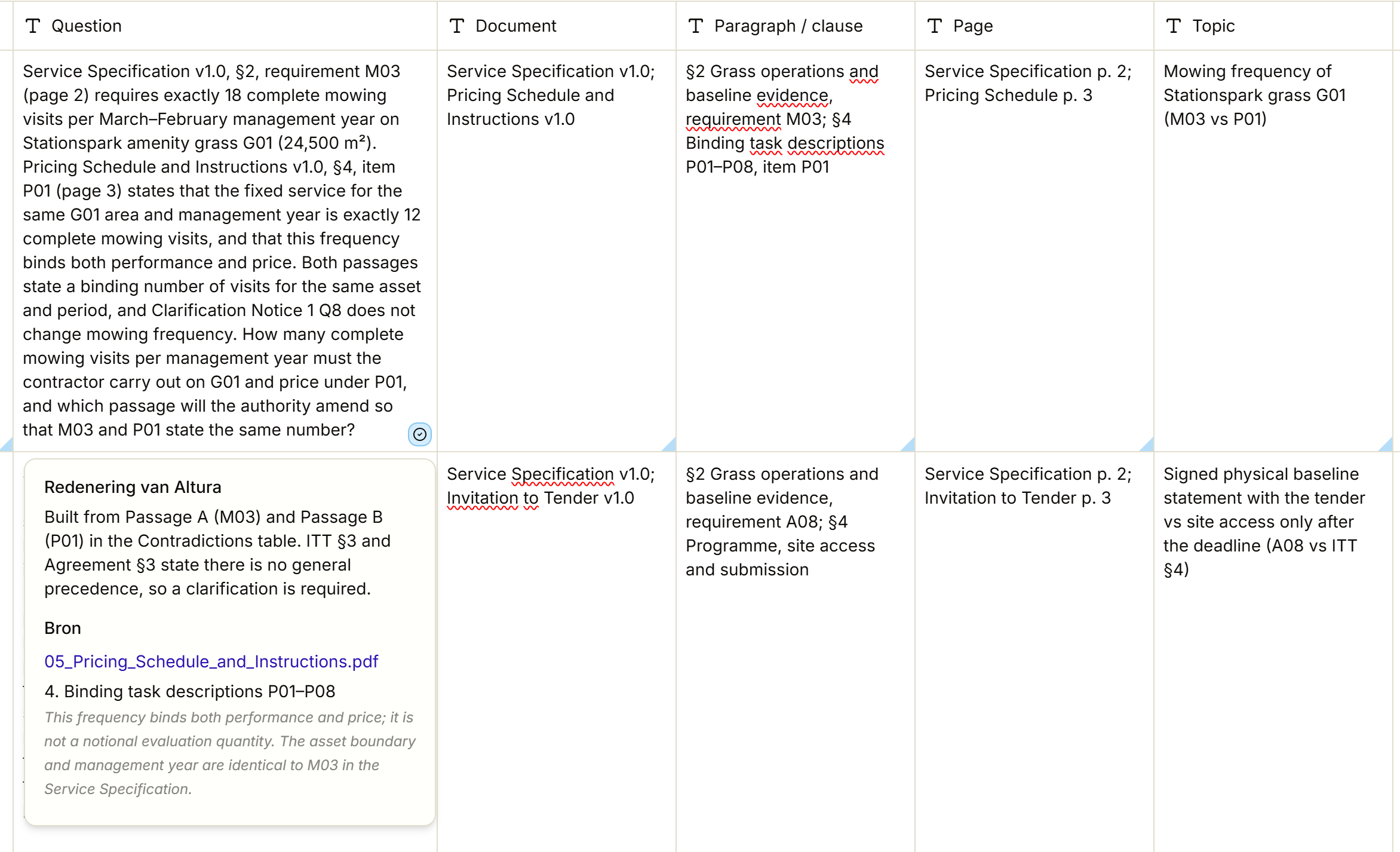
What good teams do: they start from what they already know, and work from one overview. The right questions are mostly already hidden in these five places: contradictions between tender documents, risks such as liability or penalties, requirements you can't fully meet, your standard question list and past clarification rounds. One person collects them in a single list, built on best practices, with each question traceable to its source and the reason it's being asked. That way experts review instead of write. The team decides together what gets submitted, and the quality of the questions no longer depends on who happens to run the round.
A few tips experienced bid managers use when writing the questions:
- Use three types of question. Clarify what's unclear, push boundaries (e.g. ‘Could the five required references be three?’) and propose alternatives (e.g. ‘Is this other approach acceptable?’).
- Time them. Ask fundamental questions early, so the answers still shape your bid, and detail questions closer to the deadline.
- Keep them anonymous. Every bidder reads them, so leave out company, product and method names. If a question would expose a weakness, address it in your bid instead.
- Raise objections now. In many procedures, an unclear or unreasonable requirement you don't challenge during the round is hard to challenge after the award.
Phase 2: Process the answers in one traceable overview
A few weeks later, the buyer publishes the answers, often renumbered, merged or reworded. Working out which answer belongs to which question can take hours, and that's before anyone has looked at what actually changed.
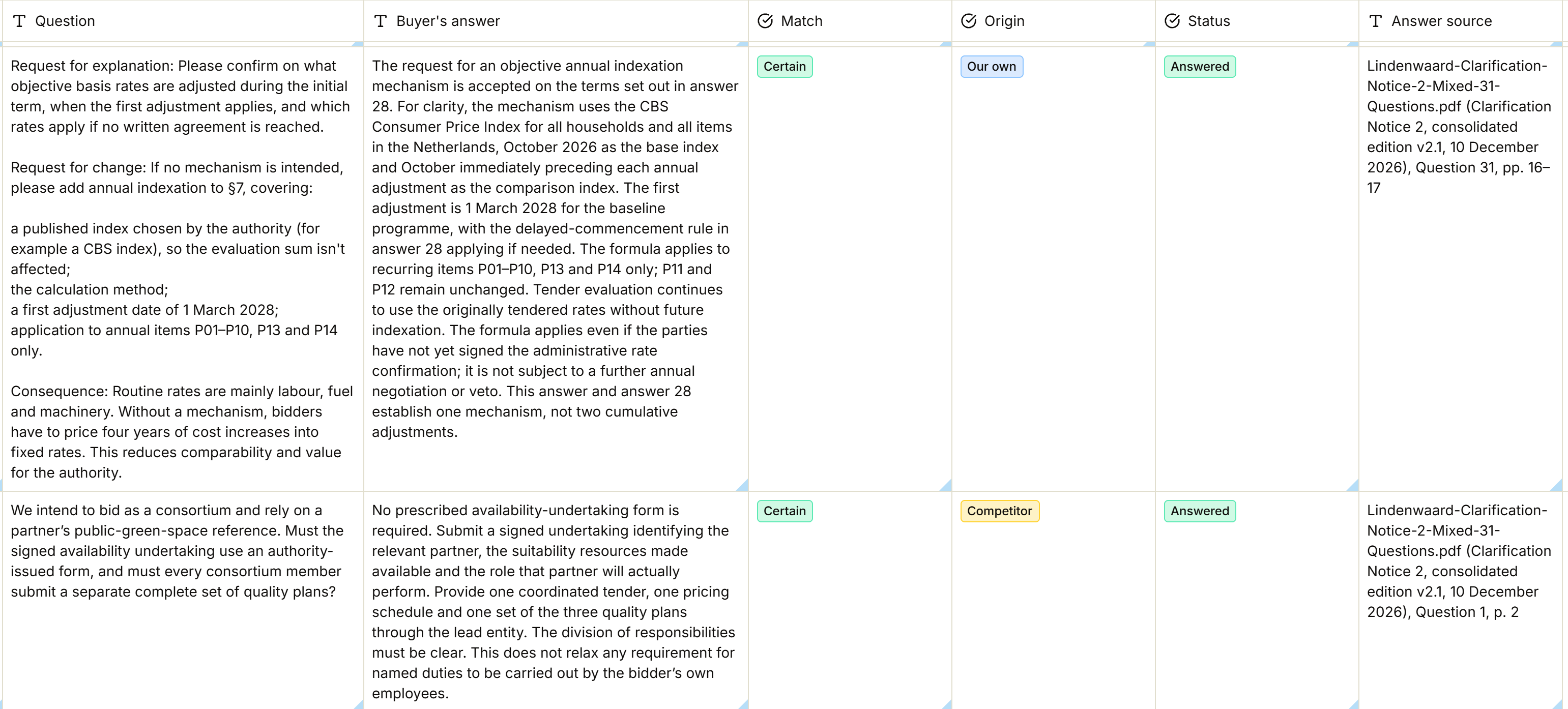
What good teams do: they build one traceable overview per tender, across every round. Every answer is matched to its question and source, the other bidders' questions are clearly marked, so they can see at a glance what changed and what needs updating. They make sure it is flagged that the answers take precedence over older versions of the tender documents, and work from that overview as the new source of truth.
Once the answers are in, these tips help you get the most out of them:
- Check whether your question was actually answered. If not, ask a follow-up in the next round.
- Read the other bidders' questions as market intelligence. A request to relax a requirement can show who's struggling to meet it, and a question about an alternative shows someone is considering it.
- Watch for walk-away signals. Evasive answers or requirements that seem written for one supplier are a reason to revisit your bid/no-bid decision.
- Keep one log of questions and answers, with sources. It keeps the team aligned, and it's your record if you ever need to challenge the outcome.
Phase 3: Turn every answer into a clear next step
An answer only helps if it reaches the person who has to act on it. This is where most bid teams feel the biggest pain: a writer answers the old question, an expert designs for a requirement that has since been relaxed, or a price is based on a requirement that no longer applies. Each one can cost you the bid, or win it on the wrong terms.
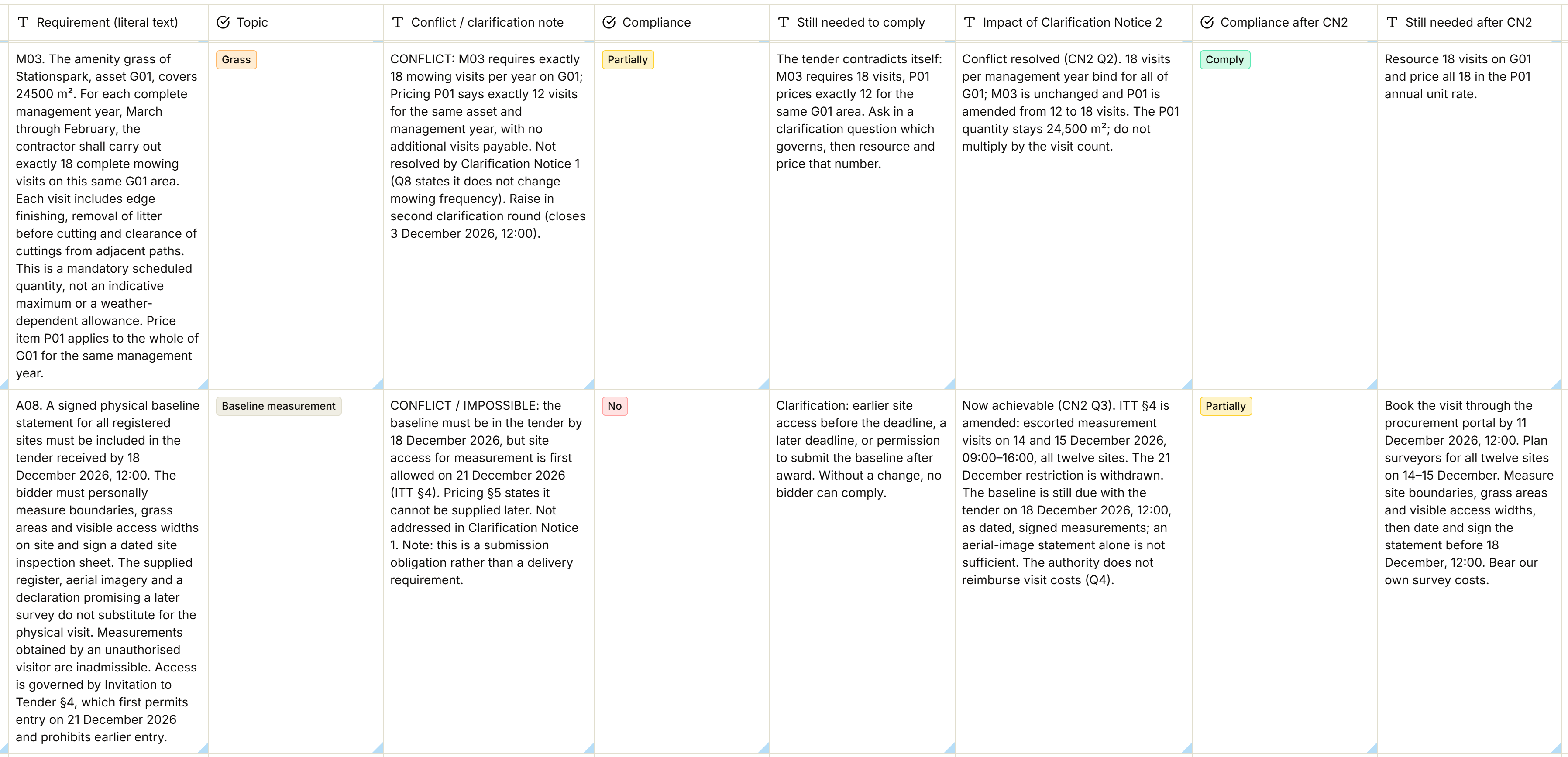
What good teams do: they make the impact of each answer visible where the team already works, with a named owner for every change, so the bid doesn’t rely on one individual. This table shows who usually needs to know what:
To make sure nothing gets missed before submission:
- Hold an impact session within a day. Walk through the changes with the writers, the experts and whoever prices the bid, instead of sending them around by email.
- Keep it all in one overview. Track every change, its owner and its status in one shared place, so everyone works from the latest version.
- Give every change one owner and a deadline, the same way you run your other workflows (read more about why you should start using workflows). And update your requirements list before anyone writes further.
- Do a final check. Before you submit, go through every changed requirement and confirm the bid reflects it.
How Altura keeps the clarification round in one connected overview
A clarification answer changes your tender, and the costliest mistakes happen when someone keeps working from outdated information. Altura, AI bid management software, connects the three phases end to end, across every phase:
- Preparing the questions: Altura suggests questions from the contradictions, risks and requirements in the tender documents and from your past rounds, all in one table, each traceable to its source.
- Processing the answers: Altura matches the buyer's answers to your questions, even when they've been renumbered, and adds the other bidders' questions to the same overview.
- Turning answers into action: Altura shows what the answers mean for your requirements, so you can tag the owner of every change.
So your team stays in control, everyone works from the latest version, and every clarification round becomes a strategic advantage.
See it on your own tender: The best way to see what one overview of the clarification round does for your team is with your own tender and your own past rounds. Book a demo
Altura is an AI bid workspace for teams that bid on public and private tenders across Europe.
Frequently asked questions
What is a tender clarification round?
A tender clarification round is the period in a tender when bidders can send questions to the buyer about the tender documents. The buyer publishes the answers, usually to all bidders, and they become part of the tender. A tender can have one or more rounds.
How many clarification rounds does a tender have?
It depends on the buyer and the procedure. Many tenders have one round, while larger or more complex tenders often have two or more. The tender documents state when you can submit questions and when the answers will be published.
Can other bidders see my clarification questions?
In most public tenders, yes. The buyer shares the questions and answers with all bidders, usually anonymised. Write every question assuming your competitors will read it.
Are clarification answers binding?
In most public tenders, the answers become part of the tender documents and take precedence over earlier versions. That's why a single answer can change what you need to offer. Check the rules of the procedure you're bidding on.
Can AI write tender clarification questions?
Yes. AI can draft questions from contradictions, risks and requirements in the tender documents, and the quality improves with your own standard questions and past rounds. What matters is that your team can see where each question comes from and decides what gets submitted.
What's the biggest mistake teams make in the clarification round?
Treating it as admin. The answers can change requirements, scope and planning, so the costliest mistakes happen when someone keeps working from the old version. One overview of every answer, with a named owner for each change, prevents that.
Sign up for our Newsletter
Sign up for great tips, tricks and other bid management news!
Discover the power of automation in 30 minutes.
We'll walk you through a live bid on your own documents, showing you how ALtura brings clarity and flow in your tenderprocess.