The Bid/No-Bid Dilemma: How Great Teams Decide Faster (and Win More)

%2520(2).avif)
The bid/no-bid decision is one of the most strategic moments in the entire tender lifecycle. It determines where time, expertise, and commercial energy will be invested. It shapes pipeline quality. It influences morale. And ultimately, it impacts win performance. Yet in many organisations, qualification remains informal. A new opportunity appears. Sales sees revenue potential. Delivery sees risk. Finance sees margin pressure. Bid teams see workload constraints. Discussions begin, often without a shared structure. The result is not alignment. It’s delay. And delay has consequences.
Related Questions
- What is a structured bid/no-bid framework?
- Why do qualification discussions take so long?
- How do high-performing teams decide faster?
- Which data should inform a go/no-go decision?
- How does coordination pressure affect prioritisation?
- How can LLM-supported workflows improve qualification clarity?
Why qualification often becomes reactive
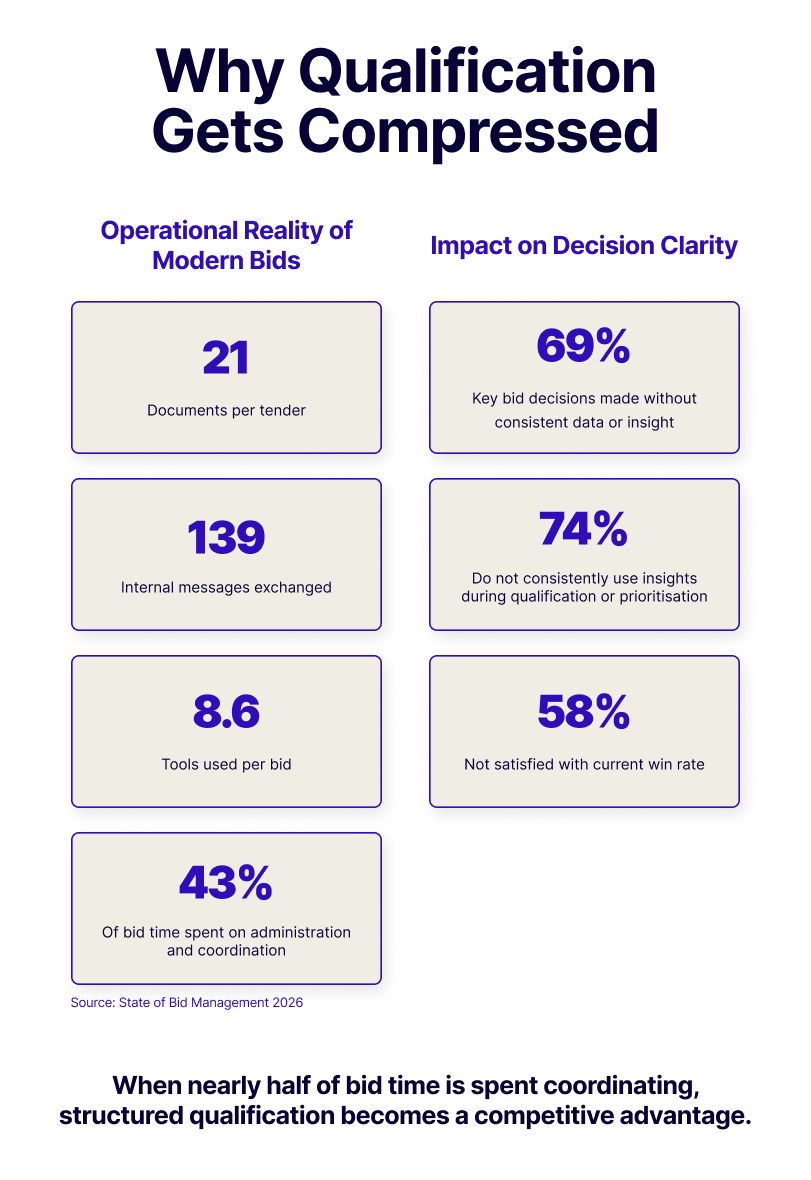
Most bid teams do not struggle because they lack experience. They struggle because their environment is fragmented. Our most recent industry research shows that a typical tender involves 21 documents, 139 internal messages, and collaboration across 8 different tools. On average, 43% of bid time is spent on administrative and coordination work rather than strategy and quality. When nearly half of available capacity is absorbed by coordination, qualification becomes reactive instead of strategic. By the time teams align, production pressure has already begun. And when time compresses, decision quality suffers.
The real risk: opinion without structure
The issue is not that teams lack judgment. The issue is that judgment is rarely formalised.
Industry data indicates:
- 69% say key bid decisions are made without consistent data or insight.
- 74% do not consistently use insights during qualification or prioritisation.
That means many go/no-go decisions rely primarily on:
- Individual optimism
- Political pressure
- Revenue temptation
- Past experience held in memory
Without documentation and structured criteria, decision logic lives in people, not in the organisation. And that creates fragility.
62% of respondents report that losing a key bid professional would have a high to very high impact on bid continuity. When decision knowledge is not institutionalised, consistency becomes dependent on availability.
| Qualification & Decision Insight | Report Finding | Implication for Bid/No-Bid |
|---|---|---|
| Key bid decisions lack structured data | 69% say key bid decisions are made without consistent data or insight | Qualification is often opinion-driven rather than evidence-based |
| Insights not embedded in qualification | 74% do not consistently use insights during qualification, prioritisation or reviews | Past performance and patterns are not systematically applied |
| Time lost to coordination | 43% of bid time is spent on administrative and coordination work | Strategic qualification time is compressed |
| Operational fragmentation | Teams collaborate across 8.6 tools per tender | Decision inputs are scattered across systems |
| Win rate dissatisfaction | 58% are not satisfied with their current win rate | Qualification and prioritisation likely need improvement |
| Dependency on individuals | 62% say losing a key bid professional would have a high to very high impact on continuity | Decision knowledge is not sufficiently institutionalised |
What structured qualification actually means
A structured bid/no-bid framework does not remove human judgment. It makes it visible.
At minimum, high-performing teams define and document:
- Strategic alignment
- Competitive position
- Relationship maturity
- Financial viability
- Delivery capability
- Risk exposure
More importantly, they:
- Assign ownership to the decision
- Capture rationale
- Reference historical performance patterns
- Make criteria explicit across teams
This transforms qualification from a debate into a repeatable process. The goal is not to eliminate nuance. It is to reduce ambiguity.
The role of data (and LLMs) in smarter decisions
Many teams already use AI or LLMs to support drafting. But drafting is not the bottleneck. The real opportunity lies earlier, in qualification.
Our most recent research shows that 69% of key bid decisions are still made without consistent data support.
LLM-supported workflows can assist by:
- Summarising opportunity documentation quickly
- Highlighting risk signals
- Extracting historical win/loss patterns
- Surfacing competitive intelligence
- Consolidating insights scattered across tools
But technology only adds value if insights are embedded at decision points.
If LLM outputs remain separate from qualification workflows, they accelerate tasks, not decisions.
Decision speed is a structural advantage
The strongest teams are not necessarily faster because they rush. They are faster because they remove friction.
When qualification criteria are predefined, when decision inputs are visible, and when insight is embedded early, discussions shorten naturally. Clarity reduces debate. And clarity protects strategic time.
Industry findings reinforce this shift: high performance starts with qualification and decision clarity.
From chasing volume to choosing deliberately
In competitive environments, the temptation is to pursue more opportunities. But high-performing bid teams operate differently. They understand that capacity is finite.
They invest where:
- Strategic alignment is strong
- Differentiation is credible
- Risk is manageable
- Delivery is realistic
They say “no” more often. Not because they lack ambition, but because they protect focus.
Altura's take: Decide better before you bid better
The bid/no-bid dilemma is not a tactical issue. It is a strategic one. When decisions rely on instinct alone, consistency suffers. When coordination dominates capacity, qualification becomes compressed. When insights are not embedded, prioritisation weakens. The teams that outperform are not those who simply work harder. They are those who build structure around judgment. They embed insight into qualification. They document decision logic. They protect strategic time. And they choose deliberately. That is where better win performance begins.
Sign up for our Newsletter
Sign up for great tips, tricks and other bid management news!
.png)
.png)
.png)
Discover the power of automation in 30 minutes.
We'll walk you through a live bid on your own documents, showing you how ALtura brings clarity and flow in your tenderprocess.