Feature: Qualification tool

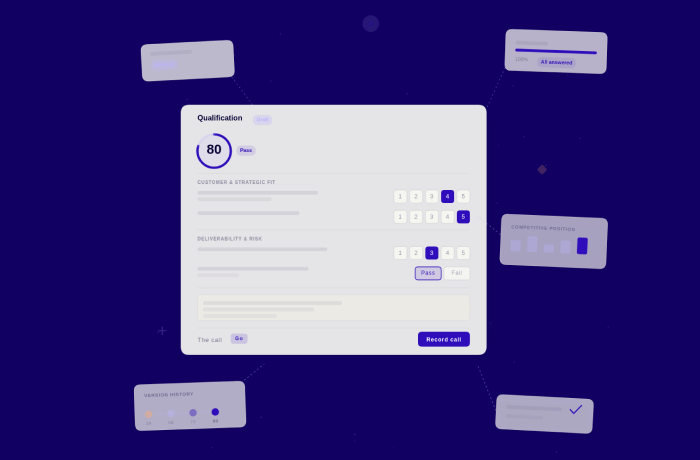
Qualification tool: structured go/no-go decisions for bid teams.
Every bid team has a moment where they decide whether to pursue an opportunity. In most organisations, that moment is informal. A salesperson flags a tender, a manager skims the documents, someone says "let's go for it." By the time anyone questions the decision, the team is already writing the proposal.
The cost of a wrong call is not just a lost bid. It is weeks of work that could have gone to an opportunity the team was better placed to win.
Altura's qualification tool turns that moment into a structured, shared assessment the whole team can build on.
Score opportunities against the dimensions that matter.
Most go/no-go decisions depend on whoever is in the room and how confident they sound. A salesperson sees revenue. The bid team has to figure out whether the opportunity is actually winnable and deliverable. Without structure, optimism tends to win.
The qualification tool gives the team a shared framework. Each opportunity is scored across defined dimensions: commercial fit, delivery capacity, competitive position, strategic alignment, financial viability. The score is not a replacement for judgement. It is a way to make judgement visible.
Each question supports a context field where the person scoring explains their reasoning. A 4 out of 5 on competitive position tells you something. Knowing it was scored that way because the team has an incumbent relationship and the main competitor lacks a certification tells you much more.
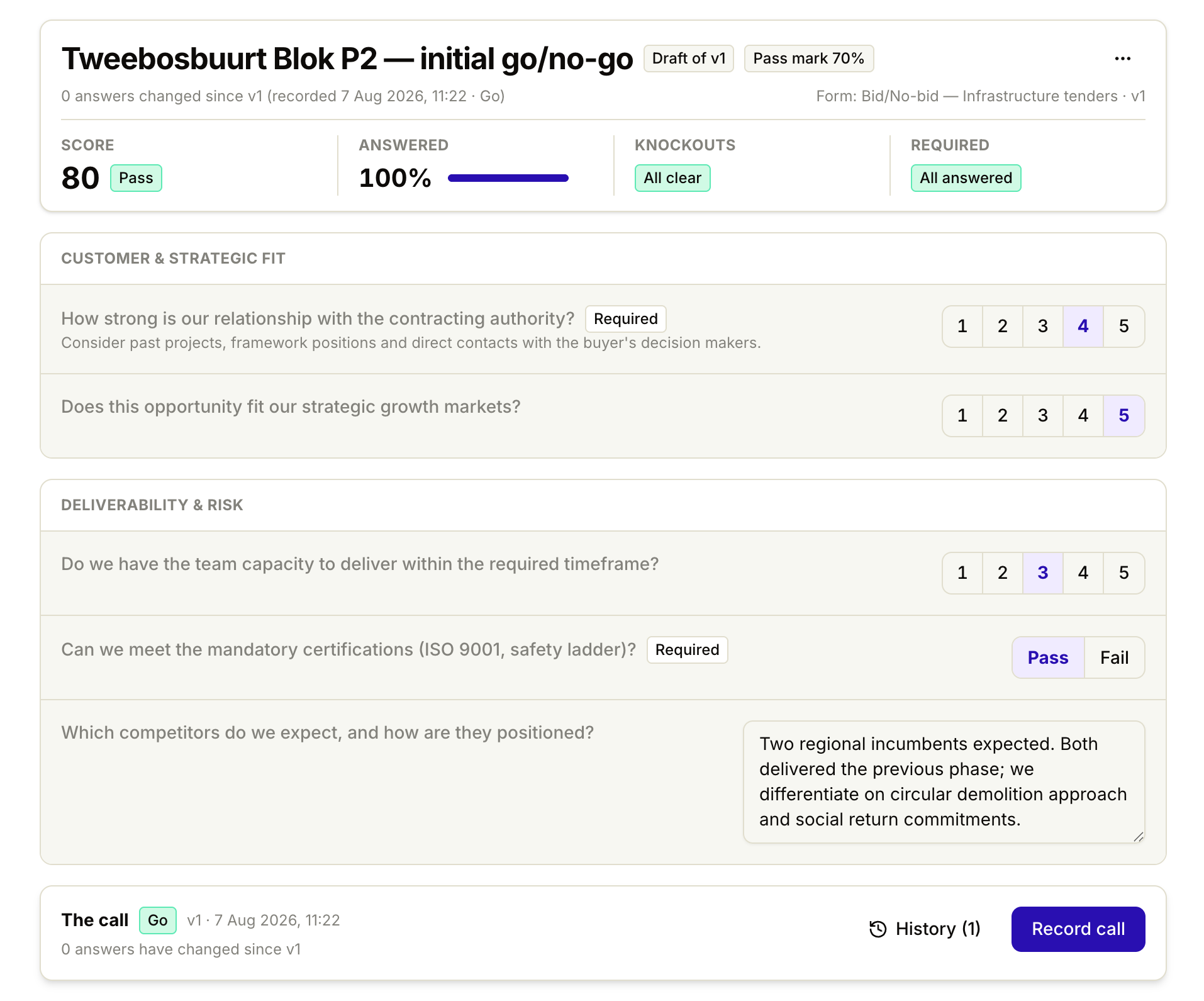
Every decision captured, attributed, and permanent.
Ask most bid teams why they pursued an opportunity six months ago and you get silence. The reasoning was never captured. The spreadsheet was overwritten. The meeting where someone said "go" left no trace.
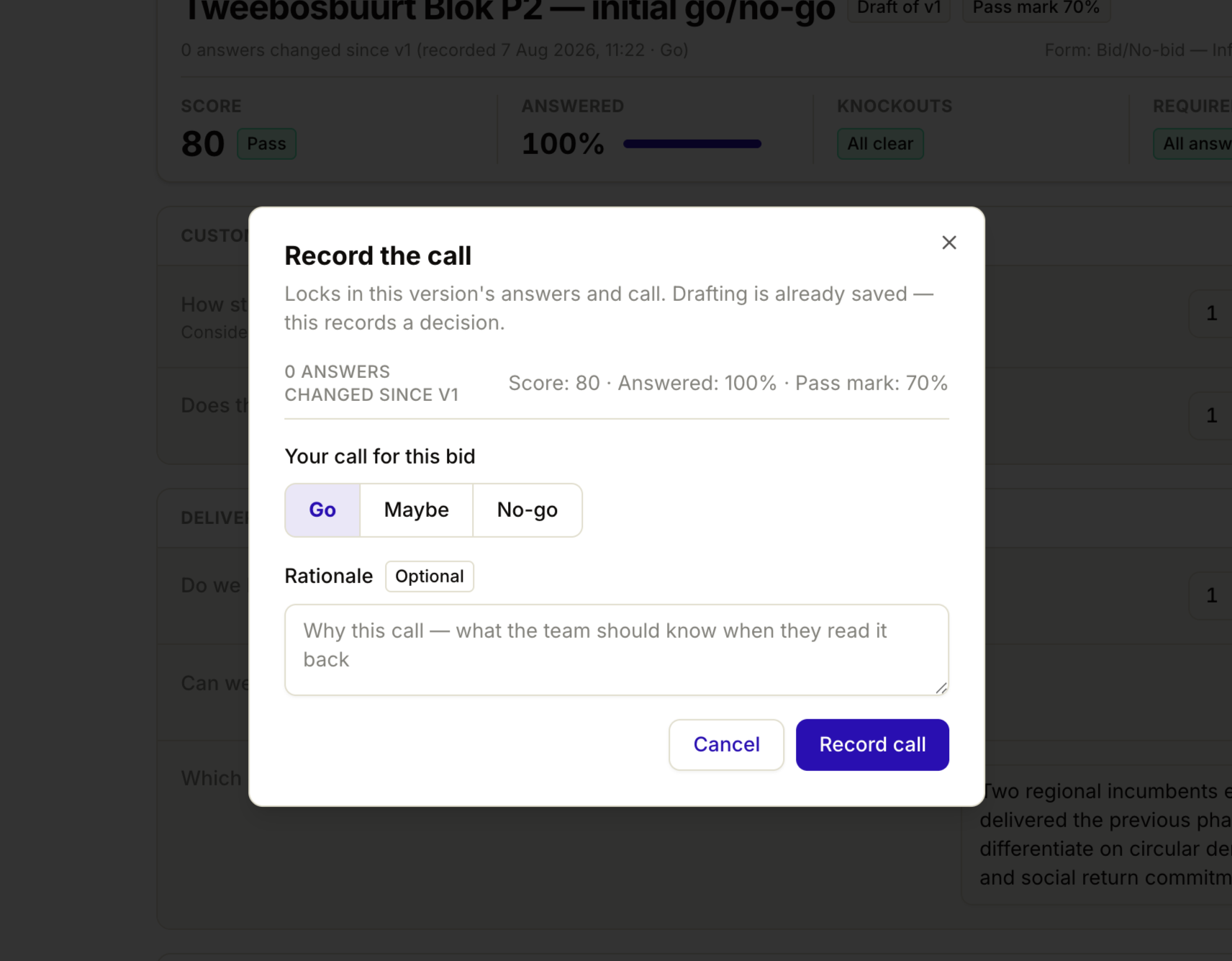
Every qualification in Altura is built to be reviewed later. When the team records a call (Go, Maybe, or No-go), the full picture is preserved: score, answers, context, rationale, who recorded it, and when. That snapshot is permanent. It cannot be edited or lost.
Colleagues can read each other's reasoning at any point. The bid manager's commercial assessment, delivery's resource flags, finance's margin checks: all visible in one place, with attribution. No one needs to be in the same meeting. The reasoning is there when you need it.
A qualification that evolves with the opportunity.
Qualification at the start of a tender is based on incomplete information. The best teams know this and reassess as the picture develops: after the full document review, after the clarification round, after learning who else is bidding.
Each time the team records a new call, Altura preserves the previous version. Over time, this creates a trajectory. An initial Maybe at 39%. A Go at 72% after clarification answered the open questions. Or a No-go when delivery confirmed they could not staff the project.
Some teams take this further. Sales completes the first qualification before a bid is even published. The gaps that surface become a work list: which stakeholders to reach, what information is missing, where the team is weak against the buyer's criteria. They go out and actively influence the buyer during the pre-publication phase. After each touchpoint they log the call and re-qualify. The thing they are watching is win probability over time. If the number rises, the influencing work is paying off. If it stays flat, they know before the RFP lands, not after.
That trajectory tells a richer story than any single score. It turns qualification from a gate into a repeated measurement tool.
.png)
Connect early decisions to eventual outcomes.
This is the part most organisations never get to.
Qualification happens at the start. Evaluation happens at the end. If those two moments are connected, you can ask: did we call this one right? What did we miss? What should we score differently next time?
When a team loses because they underperformed on sustainability, they can trace back to the qualification and check whether that risk was surfaced. If it was not, the framework gets sharper. Over time, the organisation builds a real understanding of which opportunities it wins and where its blind spots are.
How it works.
Define.
Create a reusable qualification form with scored questions (1-to-5 scale with configurable labels), dealbreaker questions (pass/fail), and open note fields. Set category weights, a pass mark, and knockout thresholds. Publish a locked version your team can use across projects.
Assess and reassess.
Start a qualification for any project. Team members answer questions and add context explaining their reasoning. Changes auto-save with attribution. The live score updates as the team works. When new information arrives, update your answers and record a new call. Each version is preserved, so the qualification score evolves alongside the opportunity.
Decide.
Record a Go, Maybe, or No-go call with a written rationale. The decision is preserved as a permanent snapshot. When the team's position changes, they update answers, work in a new draft, and record a new version when ready.
What you get.
- Reusable qualification forms with scored, dealbreaker, and open questions.
- A 1-to-5 scoring scale with configurable labels and guidance per question.
- Category weighting and caps to reflect your organisation's priorities.
- Configurable pass marks and knockout thresholds.
- Collaborative assessment where multiple team members contribute independently.
- Auto-save, attribution, and conflict detection across contributors.
- Live score and completeness indicators that update as the team works.
- Go, Maybe, or No-go calls with required rationale.
- Version history for every recorded decision so your team can see which actions or insights made the score improve over time
- Versioned forms: update your framework without breaking existing assessments.
Book a demo and discover how Altura's qualification tool can upgrade your qualification process.
Sign up for our Newsletter
Sign up for great tips, tricks and other bid management news!
.png)
.png)
.png)
Discover the power of automation in 30 minutes.
We'll walk you through a live bid on your own documents, showing you how ALtura brings clarity and flow in your tenderprocess.